
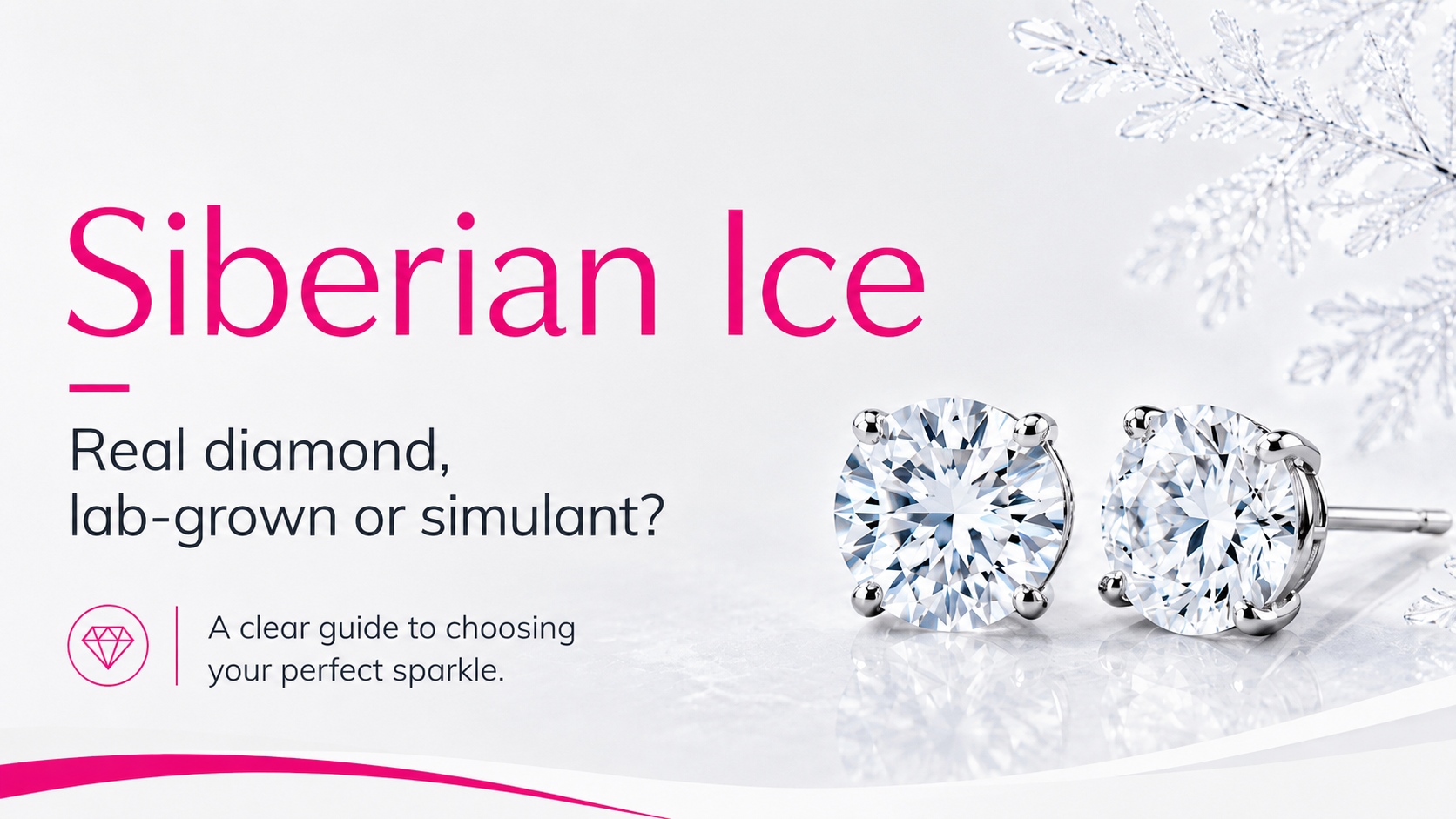
Siberian Ice Diamond Jewelry: Real Diamond, Lab-Grown or Simulant?
This post contains affiliate links. As an Amazon Associate I earn from qualifying purchases.
What is Siberian Ice diamond jewelry, and is it the same as real diamond? The short answer is no. Siberian Ice is best understood as a diamond simulant, which means it’s made to look like diamond but shouldn’t be confused with a mined or lab-grown diamond.
The name’s been around for years, then seemed to disappear from a lot of online stores. Recently, it’s started showing up again on eBay and in older jewelry listings, often with phrases such as simulated diamond, lab-created simulated diamond or Siberian Ice diamond.
That wording can be confusing. Lab-grown diamonds are real diamonds grown in a lab. Simulated diamonds are diamond-lookalike stones made from other materials. Siberian Ice belongs in the second category unless the seller provides proper paperwork proving the stone is CVD or HPHT diamond.
2026 Update: Why Siberian Ice is Showing Up Again
Siberian Ice used to appear in online jewelry ads a lot more often. Then the name became harder to find for several years. Now it’s appearing again in second-hand listings, eBay stores and old stock being resold.
That’s why it’s worth checking exactly what sellers mean by the name. If a listing says simulated diamond, lab-simulated diamond or diamond alternative, you’re not buying a real diamond. You’re buying a stone made to resemble diamond.
That’s not automatically a bad thing. Simulated stones can look pretty, cost far less and work well for earrings, travel jewelry or pieces you don’t want to worry about losing. The problem comes when the wording makes them sound like real lab-grown diamonds.
Is Siberian Ice a Real Diamond?
Siberian Ice isn’t a real diamond unless the seller can prove otherwise with a proper diamond grading report. The name itself isn’t a recognized diamond grading term.
A real diamond, whether mined or lab-grown, is made of carbon with a diamond crystal structure. A diamond simulant may sparkle like diamond, but it has a different composition.
The GIA explains that common diamond simulants include cubic zirconia, moissanite and glass. These materials can look like diamonds, but they’re not diamonds at the atomic level. And that’s the important difference that shoppers should know.
Siberian Ice vs Lab-Grown Diamonds
A lab-grown diamond is a real diamond. It has the same basic chemical makeup as a mined diamond, but it’s grown in a laboratory instead of forming underground.
Siberian Ice is usually sold as a simulated diamond. That means it may have a bright, clear diamond-like look, but it shouldn’t be described as a lab-grown diamond unless there’s proper grading paperwork.
If a seller says “lab-created Siberian Ice,” read the full description carefully. Some sellers use lab-created to mean the simulant was made in a lab. That doesn’t make it a lab-grown diamond.
Siberian Ice vs Cubic Zirconia
Older Siberian Ice marketing often made the stones sound more advanced than regular cubic zirconia. The stones were described as hard, bright, clear and resistant to clouding.
That may be true for some higher-quality diamond simulants, but it doesn’t turn them into diamonds. It’s better to think of Siberian Ice as a diamond-lookalike stone sold under a fancy trade name.
If a listing doesn’t tell you the exact material, treat it as a simulant. If it says zirconia, CZ, simulated diamond or diamond alternative, it isn’t diamond. If it’s a real diamond, trust me, the seller isn’t going to forget to mention that.
What Does Siberian Ice Look Like?
Siberian Ice can be very pretty. My own Siberian Ice earrings have plenty of sparkle.
Side by side, the difference between a real diamond and Siberian Ice isn’t dramatic in everyday lighting. Both catch the light and both look bright. The diamond has a different kind of sparkle in sunlight and under certain bright lights, but the Siberian Ice earrings still look lovely.
That’s why these stones appealed to people in the first place. They gave the look of diamond studs, rings or pendants at a much lower price.
Can a Jeweler Tell the Difference?
A jeweler might not know what a stone is from a quick glance across a counter, especially if it’s already mounted. That doesn’t mean the stone’s impossible to identify.
A trained jeweler or gemologist with the right tools can easily test whether a stone is diamond, moissanite, cubic zirconia or another simulant. Visual sparkle alone isn’t proof.
Be careful with claims like “even a jeweler couldn’t tell.” In normal life, most people won’t inspect your earrings closely. In a jewelry setting, testing equipment changes the answer.
Why People Buy Siberian Ice Jewelry
Siberian Ice jewelry is mainly about the look. It gives you bright, clear sparkle without having to pay the price of diamonds.
That can be a sensible choice for earrings, pendants, travel jewelry or pieces you don’t want to worry about losing. Stud earrings are a good example, because losing one real diamond earring would be painful!
There’s also nothing wrong with choosing an imitation stone if you know what you’re buying. Costume jewelry, silver jewelry and diamond simulants all have a place. The important thing is not paying diamond money for something that isn’t diamond.
Siberian Ice Diamond Earrings
Siberian Ice earrings are probably the easiest pieces to wear. Studs give you the diamond look without needing a large budget.
Simulants work especially well for earrings because they aren’t handled as much as rings. That means the stones can stay looking good with basic care.
If you’re looking at a pair online, check the metal as well as the stones. Sterling silver, gold plating, solid gold and base metal all affect the value far more than the Siberian Ice name.
Siberian Ice Rings
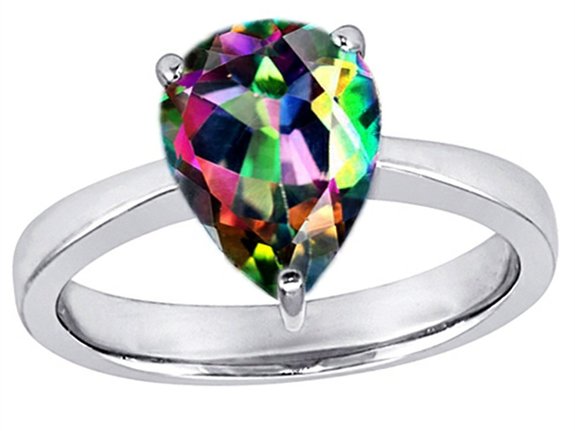
Siberian Ice rings can look striking, especially in larger carat sizes. A big simulated stone gives plenty of sparkle for very little money compared with diamond.
Rings take more wear than earrings, so check the setting carefully. Prongs, plating and band metal matter.
I wouldn’t treat a Siberian Ice ring as an investment or as a direct substitute for a valuable diamond ring. I’d treat it as pretty jewelry with a diamond-style look.
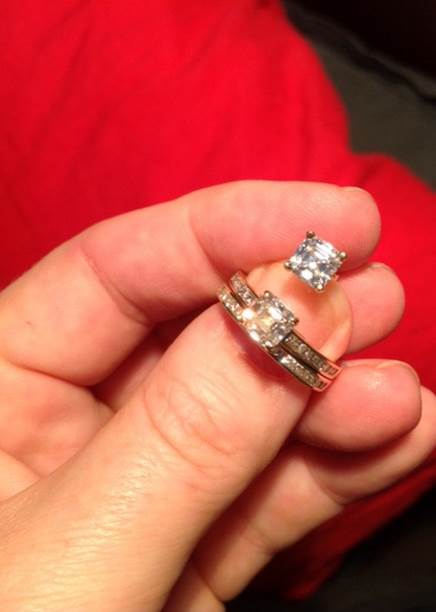
I love having a “travel ring” that looks similar to my engagement ring. It looks nearly the same, I can wear it on the beach, in the ocean, while traveling or at the gym or when I don’t want to go out wearing real diamonds. And nobody knows.
Siberian Ice Pendants
Pendants are another good use for simulated stones. They don’t get anywhere near the same wear as rings and they’re less exposed to knocks.
A pendant with a Siberian Ice stone can give you a classic diamond necklace look. The value’s going to depend mostly on the metal, the construction and the overall design.
If the listing focuses heavily on carat size but says very little about the metal, I advice reading it twice. A big simulated stone can sound impressive, but the setting’s usually what you’re paying for.
How to Read a Siberian Ice Listing
When you see Siberian Ice jewelry online, look past the headline and read the item specifics. The most useful words are usually lower down in the description.
Watch for terms such as simulated diamond, diamond simulant, zirconia, cubic zirconia, CZ, lab-simulated or diamond alternative. Those all point away from real diamond.
If a seller claims the stone is a lab-grown diamond, look for an independent grading report from a recognized lab. Words alone aren’t enough for any serious diamond purchase.
Are Siberian Ice Diamonds Worth Anything?
Siberian Ice jewelry can have value as jewelry, but not as diamond. The resale value will usually come from the metal, the brand, the design and whether anyone wants that particular piece.
The stones themselves shouldn’t be valued like diamonds, either mined or lab-grown. A large Siberian Ice stone may look impressive, but carat size doesn’t mean the same thing when the stone’s simulated.
If you’re buying second-hand, price it like fashion jewelry unless the listing proves otherwise. And if you’re selling, describe it honestly so nobody mistakes it for diamond.
Should You Buy Siberian Ice Jewelry?
Siberian Ice can be a good choice if you want sparkle, low cost and a diamond-style look. It can be especially useful for earrings, travel jewelry and occasional pieces.
It isn’t the right choice if you want a real diamond, a lab-grown diamond or jewelry with lasting stone value. In that case, look for a proper diamond grading report and clear wording such as CVD, HPHT or lab-grown diamond.
The safest approach is simple: enjoy Siberian Ice for what it is. It can be attractive jewelry, but it should be bought as a simulant, not as a bargain diamond.
Imitation Diamonds: Are They for You?
Imitation diamonds are always going to divide opinion. Some people only want real diamonds, while others are happy with sparkle at a lower price.
Before buying any diamond-style jewelry, think about why you want it. If you want an investment piece, a simulant isn’t the answer. If you want pretty earrings or a necklace you can wear without worrying, it might be ideal.
The word fake can sound harsh, but honesty matters. As long as the seller’s clear and the buyer understands what the stone is, simulated diamond jewelry can be a perfectly reasonable choice.
How to Choose an Engagement Ring
An engagement ring is more personal than any other piece of jewelry. Some people want a mined diamond, some prefer a lab-grown diamond and some are happy with a simulant because the design matters more than the stone.
For a real diamond purchase, ask for paperwork, check the metal and understand the grading. For a simulant, focus on the setting, the style and whether the price matches what you’re actually buying.
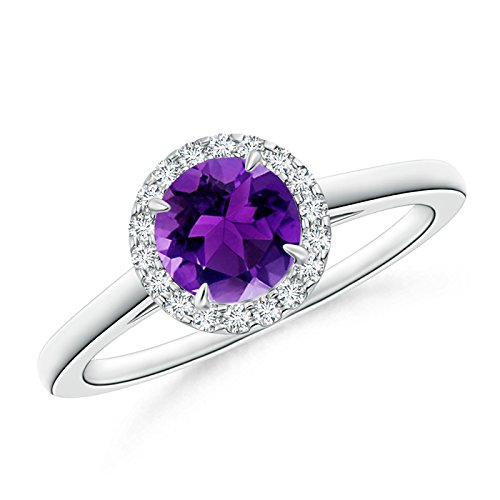
You might also be interested in opal rings, pink engagement rings, amethyst engagement rings and mystic topaz rings.
Lower income?? Wow.. some people choose not to get in debt over a stone when just starting out, some people tend to want to put that money towards other things than a rock there are many many other reasons to want a simulated stone over a diamond not just because “low income” people can’t get anything else. De beers already said diamonds are not precious and are worthless, they said they are selling the tradition, you can look it up yourself. Thinking only people with “low income” only get simulant’s is obsurd. I have friends who have lived in Africa and refuse to buy any sort of diamond and it’s not because they are “low income”. Poor choice of words..
That was only one reason to choose these – I’ve given many others. I also mentioned the blood diamonds reason. And yes, there are others. You’re right, someone starting out who wants to invest in a home rather than a rock has a good reason. The fact is diamonds are available and simulated diamonds are available (as well as many other stones), and people these days have the choice since it’s an individual thing. I just wanted to share the Siberian Ice simulated diamonds because someone might find that the perfect solution for what they’re looking for. Something is only worth what somebody is willing to pay, after all. If someone chooses to blow hundreds of thousands on what is basically a piece of rock, that’s their prerogative.